 Rehome Pets
Things worth ruling out first
Plenty of rehomings are unavoidable. Some are not, and it is worth half an hour to check which one you are dealing with, because the alternatives are less painful than rehoming if any of them apply.
- Housing. If a landlord or a move is the problem, look specifically for pet-friendly rentals before concluding there are none, and check whether a pet deposit or a pet CV of references would change your landlord's answer. Some jurisdictions also restrict blanket no-pet clauses.
- Cost. If it is veterinary bills or food, many areas have low-cost veterinary clinics, charity vet schemes and pet food banks. Ask your vet directly what payment plans or charitable funds they work with — they field this question constantly and will not judge you for it.
- Behaviour. Most of the behaviours that cause people to rehome dogs — pulling, barking, reactivity on lead, separation anxiety, house-soiling — are treatable with a qualified behaviourist. A few sessions cost less than most people expect and often less than the emotional cost of rehoming.
- A temporary crisis. If the problem is hospital treatment, a deployment, fleeing domestic abuse, or a few months of instability, temporary fostering exists. Some rescues run foster programmes precisely so that people do not have to give up an animal permanently over a temporary situation.
- A new baby or a pregnancy. This is very often solvable with preparation and management rather than rehoming. Talk to your vet and a behaviourist before deciding.
If you have been through these and rehoming is still the answer, that is a legitimate conclusion. Continuing to keep a dog whose needs you genuinely cannot meet is not the kinder choice. The rest of this guide is about doing it properly.
Getting your dog ready
A dog that is ready to go finds a home faster and holds it better.
- Vaccinations up to date, and the record in hand.
- Neutering, if appropriate for the dog's age and health. An unneutered dog attracts a different and less desirable set of enquiries.
- Microchip details current — you will need access to the registration to transfer it.
- Flea and worm treatment done recently.
- Veterinary history collected, including anything ongoing.
- A written routine. Feeding times and amounts, the food brand, walk schedule, commands the dog knows, where it sleeps, what frightens it, how it behaves when left. This document is worth more to a new owner than anything else you hand over.
Where to list a dog for rehoming
| Option | You pick the home | Typical timescale | Watch out for |
|---|---|---|---|
| Rehoming app | Yes | 2–4 weeks | You do the screening yourself |
| Breed-specific rescue | No | Days to months | Waiting lists; only takes that breed |
| Friends, family, colleagues | Yes | Immediate or never | Hard to say no, hard to take the dog back |
| Your vet's noticeboard | Yes | Unpredictable | Small audience, but a self-selecting one |
| Shelter surrender | No | Immediate, if there is space | Surrender fee; no say in the outcome; intake may be capped |
| Craigslist / Facebook | Yes | Fast | No accountability; actively trawled by bad actors |
Most people do best running two routes at once: a rehoming app for reach, and an enquiry to the relevant breed rescue in case they have a suitable home already waiting.
List your dog
Screen applicants, message securely, and keep your contact details private until you choose otherwise.


7-day free trial, then a paid subscription. Cancel anytime.
Writing a listing that works
Two things decide whether you get good applicants: photographs, and how honest you are.
Photographs
- Six to eight, taken outside in daylight or by a window. No flash.
- At least one full-body shot standing side-on, so size and build are obvious.
- One head shot with the eyes visible and in focus.
- One of the dog doing something ordinary — on a walk, asleep, being stroked.
- If the dog is good with children or other animals and you can safely photograph that, do.
The description
Write in concrete detail rather than adjectives. Compare:
"Bailey is a lovely, friendly boy who deserves a loving home."
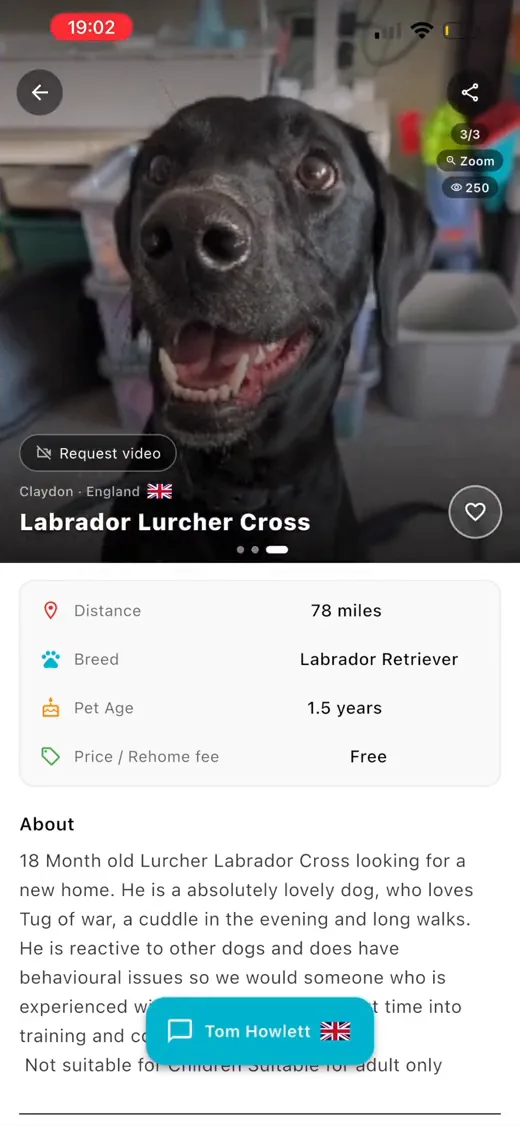
"Bailey is a four-year-old neutered lurcher, about 22kg. He sleeps through the night on his bed in the kitchen, walks well on a harness, and is quiet in the house. He is thrilled by every human he meets, ignores cats, and cannot be let off lead because he will chase squirrels for a mile. He has been left for four hours without any problem. He is frightened of the vacuum cleaner."
The second one gets fewer enquiries and far better ones. Include:
- Age, breed or best guess, weight, sex, neutered or not.
- Good with children? Which ages? Good with dogs? With cats?
- House-trained? Crate-trained? Recall?
- How long it can be left alone.
- Any medical condition, ongoing medication, or known behavioural issue.
- Why you are rehoming. If you leave this out, applicants assume something is being hidden.
- What the right home looks like — secure garden, no small children, someone home most of the day, an only-dog household.
Do not soften the problems. A dog rehomed on a rosy description comes back, or worse, gets passed on again by someone who feels misled. Every genuine difficulty you disclose filters out an adopter who would have failed later.
Screening adopters
Ask everyone the same questions and keep the answers. You are looking for consistency and for people who have thought past the first week.
- Who lives in the home, and how old are the children?
- What other animals do you have? Neutered? Vaccinated? How would you introduce them?
- Do you own or rent? If renting, does your agreement permit dogs — can you show it?
- Is the garden fenced, and how high?
- How many hours a day would the dog be alone, and where would it be?
- What are your working hours, and who is home during the day?
- Which vet practice would you register with?
- Have you owned a dog before? What happened to it?
- What would you do if the dog developed a health problem costing several thousand?
- What would make you decide you could not keep it?
The vet reference is the best check you have. If someone has had dogs before, ask for their vet practice and permission to call. One phone call confirms whether previous animals were registered, vaccinated and seen when they needed to be. It takes five minutes and tells you more than an hour of conversation.
Walk away if you see: pressure to hand over the dog immediately, refusal of a home visit, the dog being a surprise gift for someone else, interest in whether the dog could be bred from, evasiveness about where it will sleep, unwillingness to sign an agreement, an address that keeps changing, or an offer of significantly more money than you asked for. You never owe anyone an explanation for saying no.
The meeting and the home visit
Meet in a neutral public place first — a park, a car park, somewhere the dog is not defending territory. Bring someone with you. Watch how the person behaves around the dog rather than how the dog behaves around them: whether they crouch rather than loom, whether they let the dog approach, whether they are still interested when it ignores them.
Then go and see where the dog will live. This is the step people most often skip and most often regret skipping. You are checking that the house and the garden are as described, that everyone in the household knows a dog is coming, and that the other animals are as represented. If someone will not let you see the home, you have your answer.
Where possible, arrange a trial period of a week or two, agreed in writing, with a clear understanding that the dog comes back to you if it does not work.
The rehoming agreement
Write it down. Both parties sign, both keep a copy. It should cover:
- Names and addresses of both parties.
- The dog's description, age, microchip number and veterinary history.
- Everything you disclosed about health and behaviour — this protects you as much as the adopter.
- The date of transfer and any fee.
- A return clause: if the adopter can no longer keep the dog, it is returned to you. It is not sold, given away, or surrendered to a shelter.
- An undertaking to provide appropriate veterinary care and not to breed from the dog.
- Whether you have agreed to any follow-up contact, and how often.
The return clause is the most important line in the document. It is the thing that stops a dog entering the chain of hands that ends badly.
The handover
- Send the dog with its own bed, blanket, toys, collar, lead and current food. Familiar smells matter, and an abrupt food change on top of everything else causes stomach upsets.
- Hand over the written routine and all veterinary records.
- Transfer the microchip registration to the new owner. This is a legal requirement in some countries and a good idea everywhere. Do it on the day.
- Tell the new owner about your vet practice so records can be requested.
- Keep the goodbye short and calm. Dogs read distress, and a long emotional farewell makes the transition harder for them, not easier.
- Agree the check-in in advance — a message at one week and one month is typical. Then let them get on with it.
Rehoming a puppy
Puppies find homes quickly, which is precisely the risk: speed removes the screening you would otherwise do.
- Do not let a puppy go before eight weeks. Puppies separated earlier miss critical socialisation with their mother and littermates, and in many places it is illegal to sell or transfer them younger.
- First vaccinations and worming should be done, with the record to hand.
- Be alert to resellers. Free or cheap puppies are actively sought by people who will flip them. Enquiries that arrive within minutes, want several, ask about the litter rather than the individual, or are vague about where they live deserve real scrutiny.
- A "free to good home" puppy advert is the highest-risk listing there is. If you are set on not charging, at minimum screen hard, do a home visit, and use an agreement.
- Be honest about the mother and the litter, including any that did not survive and any health problems that showed up.
Coping with it
This part gets left out of most guides, and it is the part people actually search for at two in the morning.
Expect grief that behaves like bereavement — it comes in waves, it ambushes you at the times of day you used to walk, and it is worse for being a loss you chose. Expect guilt that is out of proportion to the facts. Both of those are normal and neither is evidence that you decided wrongly.
A few things genuinely help:
- Do the process carefully. This is the single best protection against later regret. People who met the family, saw the home, and signed an agreement cope far better than people who handed a dog to a stranger in a car park, because they know something concrete about where their dog is.
- Write down why. On a bad night, the reasons that were obvious in daylight get hard to recall. Having them written down in your own words helps.
- Agree the updates in advance, and keep them limited. Occasional photographs help most people. Continuous contact tends to prolong it for you and unsettle the dog.
- Give it time before getting another dog. A replacement acquired during the acute phase rarely goes well for either of you.
- Talk to someone who has done it. Rehoming carries a stigma that does not survive contact with people who have been through it, most of whom will tell you their dog was fine.
The measure of whether you did right by your dog is not whether you kept it. It is whether the home it went to can give it what it needs.
Frequently asked questions
How do I rehome my dog for free?
Rehoming your dog privately costs nothing in itself: breed-specific rescues generally do not charge the owner, and friends, family and a vet noticeboard are free. Shelter surrender is the option most likely to carry a fee. Listing apps vary — some are free, some are subscription-based — so check before you invest time in a listing. Whichever you use, the real cost is your time, because the screening is yours to do. See what rehoming costs.
How long does it take to rehome a dog?
Two to four weeks is realistic for a healthy, sociable dog of a common breed in a populated area. Senior dogs, large breeds, dogs that cannot live with children or other animals, and dogs with medical or behavioural needs often take two to three months. Do not set a deadline you are not able to extend.
Should I charge a rehoming fee for my dog?
A modest fee filters out the most casual enquiries, but it is not real protection, because anyone acquiring dogs for the wrong reasons can afford it. Screening, a home visit, a vet reference and a written agreement do far more to keep a dog safe than a fee does.
Is it cruel to rehome a dog?
No. Dogs form new attachments, and most settle into a new home within a few weeks. Rehoming a dog into a household that can meet its needs is a better outcome than keeping it in one that cannot. What causes lasting harm is a chain of short placements — which is why choosing the home carefully matters more than choosing quickly.
Can I rehome a dog with a bite history?
Not through an ordinary private rehoming. A dog that has bitten needs a behavioural assessment and, in most cases, a specialist rescue or an experienced placement arranged with full written disclosure. Passing a dog with a bite history to a private adopter transfers real risk to them and, in many jurisdictions, potential liability to you.
How do I cope with rehoming my dog?
Expect grief, and expect guilt that does not match the facts. Doing the process carefully — screening properly, meeting the family, seeing the home — is what makes it bearable afterwards, because the decision stops being abstract. Ask the new family for occasional updates, but agree in advance how often, so the break is clean for the dog.