 Rehome Pets
The short answer
A rehoming fee is an optional amount a pet's current owner asks the new owner to pay when the pet moves to a new home. It usually reflects vet work already done — vaccinations, neutering, microchipping — and is meant to put off impulse enquiries, not to make a profit.
Typical private rehoming fees run roughly $50–$250 (£50–£250) for a dog and $25–$100 (£25–£100) for a cat, and plenty of owners charge nothing. Rehoming does not mean free: it means finding the right home, with or without a fee.
What a rehoming fee covers
Owners ask a rehoming fee for three reasons, and most fees are a mix of all three.
- Costs already paid. Vaccinations, neutering, microchipping, flea and worm treatment and a recent vet check save the new owner real money. A fee that roughly reflects that is easy to justify.
- Things that go with the pet. A crate, cage, hutch, vivarium, carrier or bedding has value, and some owners fold it into the fee.
- A filter on enquiries. Someone unwilling to pay anything at all has often not thought the decision through. A modest fee thins out the impulse messages.
A rehoming fee is different from a shelter or rescue adoption fee, which is set by the organisation and usually covers its own vet work, kennelling and running costs. It is also different from a surrender fee, which some shelters charge the owner for taking an animal in.
How much is a rehoming fee?
There is no official rate. These are the ranges commonly seen in private rehoming listings — useful for judging whether a fee is in the normal range, not rules. They are shown in dollars and pounds; wherever you live, comparable local listings are the best guide to what is normal.
| Pet | Typical fee ($) | Typical fee (£) | What moves it |
|---|---|---|---|
| Adult dog | $0–$250 | £0–£250 | Neutered, vaccinated, chipped and trained push it up; age and medical needs bring it down |
| Puppy | $50–$300 | £50–£300 | First vaccinations and vet check done; very young puppies should stay with their mother until 8 weeks |
| Cat or kitten | $0–$100 | £0–£100 | Neutering and vaccinations; adult and senior cats are often rehomed with no fee |
| Rabbit or bonded pair | $0–$75 | £0–£75 | Neutered and vaccinated; whether a hutch or run goes too |
| Bird | $0–$50 small; more for parrots | £0–£50 small; more for parrots | Species, age, and whether the cage goes with the bird |
| Reptile | $0–$150 | £0–£150 | Mostly the value of the vivarium, lighting and heating included |
| Hamster, guinea pig, rat | $0–$30 | £0–£30 | Mostly the cage and supplies |
Pedigree animals with papers can sit well above these ranges. At that point the listing is closer to a sale than a rehoming, and the rules that apply may change — see the FAQ below.
How to set your fee
- Add up what the next owner will not have to pay. Vaccinations, neutering, a microchip and a recent health check are the main items. That total is a sensible ceiling.
- Look at comparable local listings. Same species, similar age, similar vet history. A fee far above them slows the search; far below can attract the wrong attention.
- Lower it for harder placements. Senior pets, large breeds, and animals that cannot live with children or other pets take longer to place. Removing the fee widens the pool.
- Write it down. Put the fee, what it includes, and whether any of it is refundable into the rehoming agreement.
A middle option: some owners ask a fee and then donate it to a local rescue. It keeps the filtering effect without any suggestion of profit, and is easy to explain in a listing.
Does rehoming mean free?
No. "Rehoming" describes finding a pet a new home; it says nothing about price. Some owners rehome with no fee and some ask one. What the word usually does signal is that the owner cares more about the right home than the money, and expects to screen applicants, visit the home and use a written agreement.
If you do rehome with no fee, avoid the phrase "free to a good home". It is searched for by people acquiring animals cheaply to resell. Say instead: "No rehoming fee. Home visit and references required." More on this in Is rehoming free?
What a fee will not do
A fee is a weak filter, not a safeguard. Anyone acquiring animals for the wrong reasons treats a modest fee as a cost of doing business. What actually protects your pet:
- Asking every applicant the same specific questions.
- Calling their vet for a reference on previous animals.
- Visiting the home where the pet will live.
- A written rehoming agreement with a clause that the pet comes back to you rather than being passed on.
Do those four things and the fee — or no fee — makes little difference. The full process is in how to rehome a dog and how to rehome a cat.
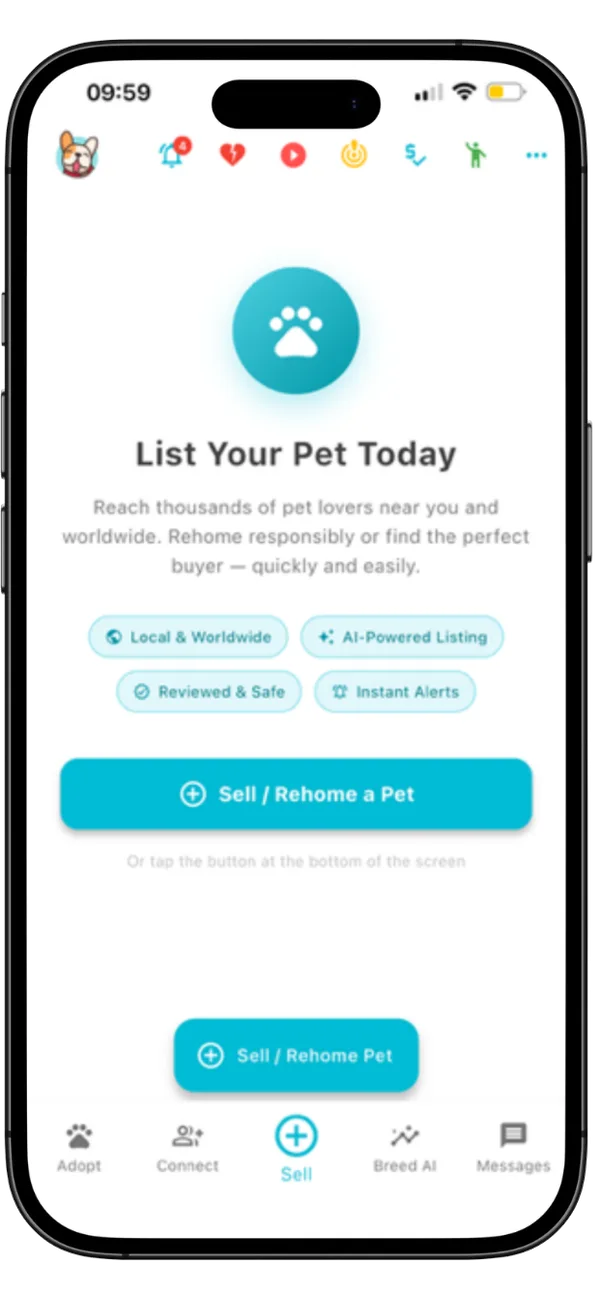
List your pet, set your own fee
Write the listing, choose the fee — including none — and talk to interested people in the app without giving out your number.


7-day free trial, then a paid subscription (see current prices). Cancel anytime. The app never takes a cut of your rehoming fee.
Taking the fee safely
If you are the owner:
- Take the fee at the handover, in person, after the home visit — not before.
- Be wary of anyone who offers more than you asked, wants to pay by cheque or "send a courier", or is buying the pet as a gift for someone you will never meet.
- Give a simple receipt and keep a copy of the signed agreement.
If you are the one paying:
- Never pay a deposit, shipping or "insurance" for a pet you have not met in person. Pet deposit scams are among the most common online frauds worldwide.
- Never pay by bank transfer to a stranger, gift card or cryptocurrency.
- Ask to see vaccination and vet records, and check the microchip is registered to the person you are dealing with.
Frequently asked questions
What is a rehoming fee?
An optional amount a pet's current owner asks the new owner to pay when the pet moves to a new home. It usually reflects vet work already done, such as vaccinations, neutering and microchipping, and is meant to deter impulse enquiries rather than to make a profit. The owner decides whether to charge one and how much.
Does rehoming mean free?
No. Rehoming means finding a pet a new home; it says nothing about price. Some owners rehome with no fee and some ask a rehoming fee. A listing that says rehoming usually signals that the owner cares more about the right home than the money, and expects to screen applicants.
How much is a rehoming fee for a dog?
Private rehoming fees for adult dogs are commonly somewhere around $50 to $250 (about £50 to £250), or a similar amount in your local currency. Fees sit at the higher end when the dog is young, neutered, vaccinated and microchipped, and at the lower end, or zero, for senior dogs and dogs with medical or behavioural needs. These are typical ranges, not rules.
How much is a rehoming fee for a cat?
Commonly around $25 to $100 (about £25 to £100), depending mainly on whether the cat is already neutered, vaccinated and microchipped. Many owners rehome adult and senior cats with no fee.
Is a rehoming fee the same as selling a pet?
In law, money changing hands for an animal is generally treated as a sale, whatever it is called. The practical difference is intent: a rehoming fee is set to cover costs and filter enquiries, and the owner screens the new home. A private owner rehoming their own pet is not usually treated as running an animal business, but rules differ by country, state and council. In England, for example, anyone in the business of selling animals needs a council licence, and third-party sales of puppies and kittens under six months are banned under "Lucy's Law". If you are unsure, check with your local authority.
Is a rehoming fee refundable?
Only if you agree that it is. The cleanest approach is to write it into the rehoming agreement: for example, that the fee is not refundable, or that it is refunded if the pet is returned to you within a set trial period. Never take a deposit before the person has met the pet.